Electric Shaker Bottles for Sports Nutrition Brands
For a sports nutrition brand, the shaker is the product your customer holds every day. This guide covers mixing, capacity, branding and ordering — what to check before you commit to 1,000 pieces.
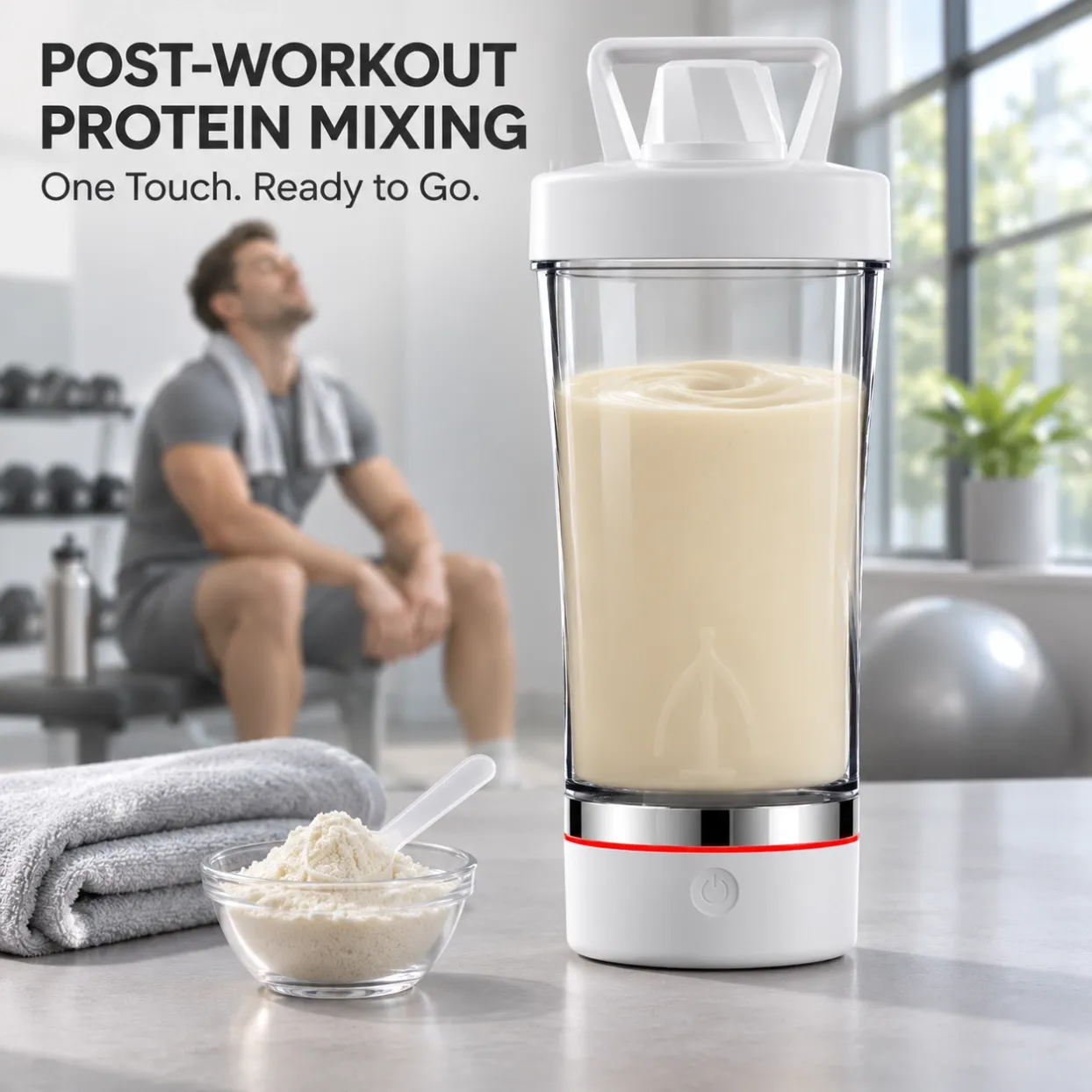
Your shaker is the product your customer touches every day
Most sports nutrition brands give the shaker away. It arrives in the first order, or free with a tub of protein, and from that moment it is the product the customer actually touches every day — more often than the powder itself. When it leaks in a gym bag, leaves clumps at the bottom, or stops holding a charge after a month, the customer does not blame the shaker factory. They blame the brand on the label.
Choosing a shaker is therefore not a packaging decision. It is a brand decision, and it deserves the same care as the formula inside the tub. A good shaker makes the first scoop easy, the daily routine pleasant, and the brand visible on the gym floor. A bad one does the opposite, quietly, every single day.
Why the shaker carries your brand
Think about where your product gets used. A tub of protein lives in a kitchen cupboard. The shaker travels: to the gym, to the office, on the commute, on a run. Every time it comes out, your logo is on display in front of people who buy the same kind of product. No other piece of merchandise a nutrition brand owns gets that much honest exposure.
It is also the first thing a new customer judges you by. The powder might be excellent, but the first experience is the mix: scoop in, shake, drink. If that goes smoothly, the customer comes back for a second tub. If it does not, many never find out how good the powder was. Brands that treat the shaker as a throwaway item often learn this the expensive way, through reviews and returns that have nothing to do with their formula.
The shaker also drives repeat business in a way few free gifts do. A customer who uses your shaker daily is a customer who thinks of your brand daily. When the shaker wears out, they come back for another — and while they are there, they buy more powder. Some brands turn this into a small range of its own: a standard shaker in the first-order kit, a premium steel mug as a loyalty reward, a limited colour for a new product launch. If you want ideas for that kind of programme, our guide to choosing a shaker for protein shakes covers how different bottles fit different routines.
What to look for before you order
Not every electric shaker suits a nutrition brand. Here is what matters, in the order your customers will notice it.
Mixing that actually works
This is the whole point of the product. A shaker that leaves clumps at the bottom gets thrown away, and your brand goes with it. Look for a motor that blends a full scoop smoothly — across the range we make, motors run from about 7,000 to 18,000 rpm — and a stirrer that reaches the whole cup, not just the centre. A Y-shaped stirrer or a proper vortex does the job; a weak motor with a short paddle does not. If you can, test with the thickest shake you sell, not the thinnest.
Leak-proof, every time
Your customer will put this in a bag next to a phone, a laptop, or gym clothes. A lid that seals properly and a base that stays shut matter more than any extra feature. A flip-top lid with a drinking spout is the format most people expect now, and it should open and close one-handed. Ask how the seal is made and whether the base can be taken off for cleaning — a detachable base is easier to wash and easier to check.
Capacity that fits a real serving
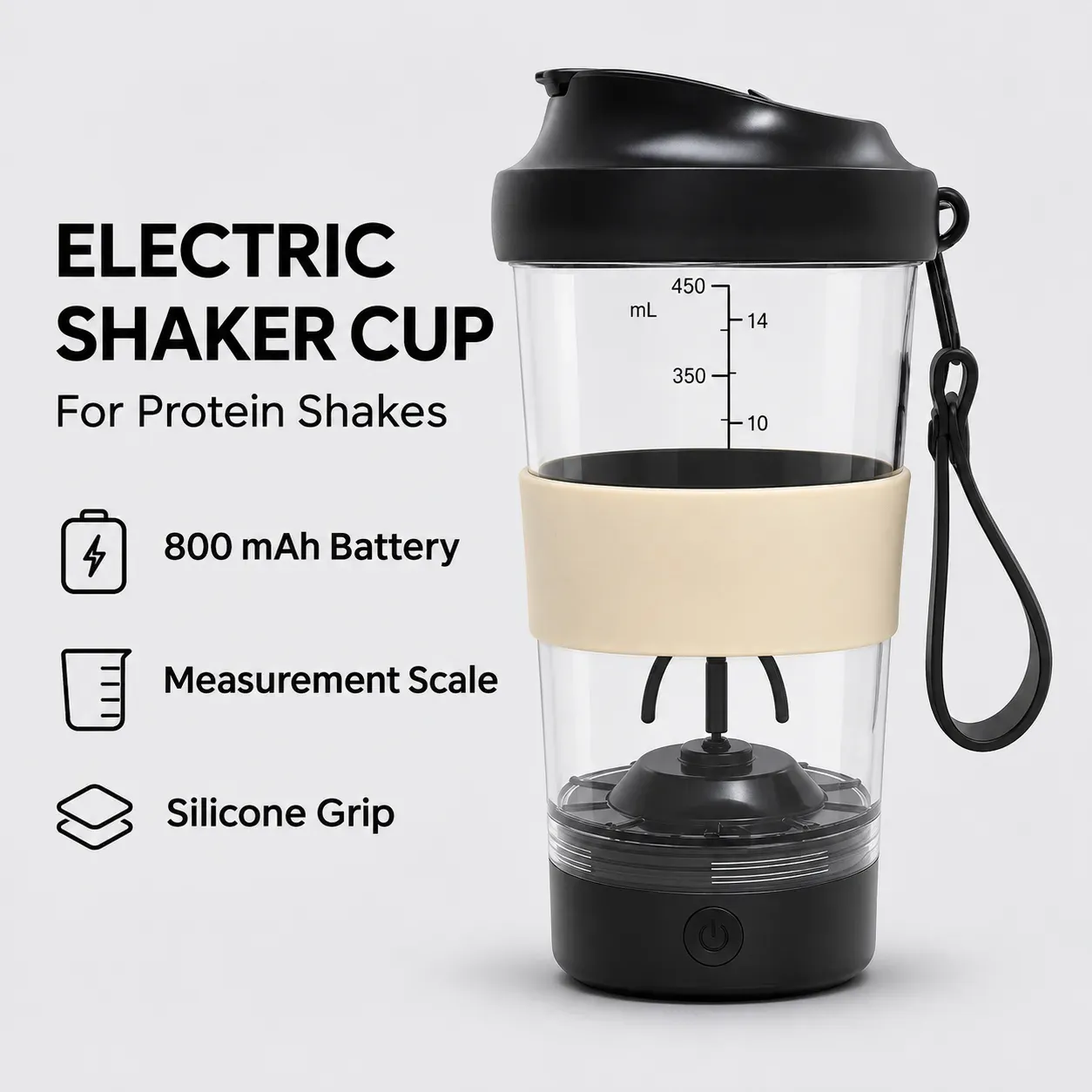
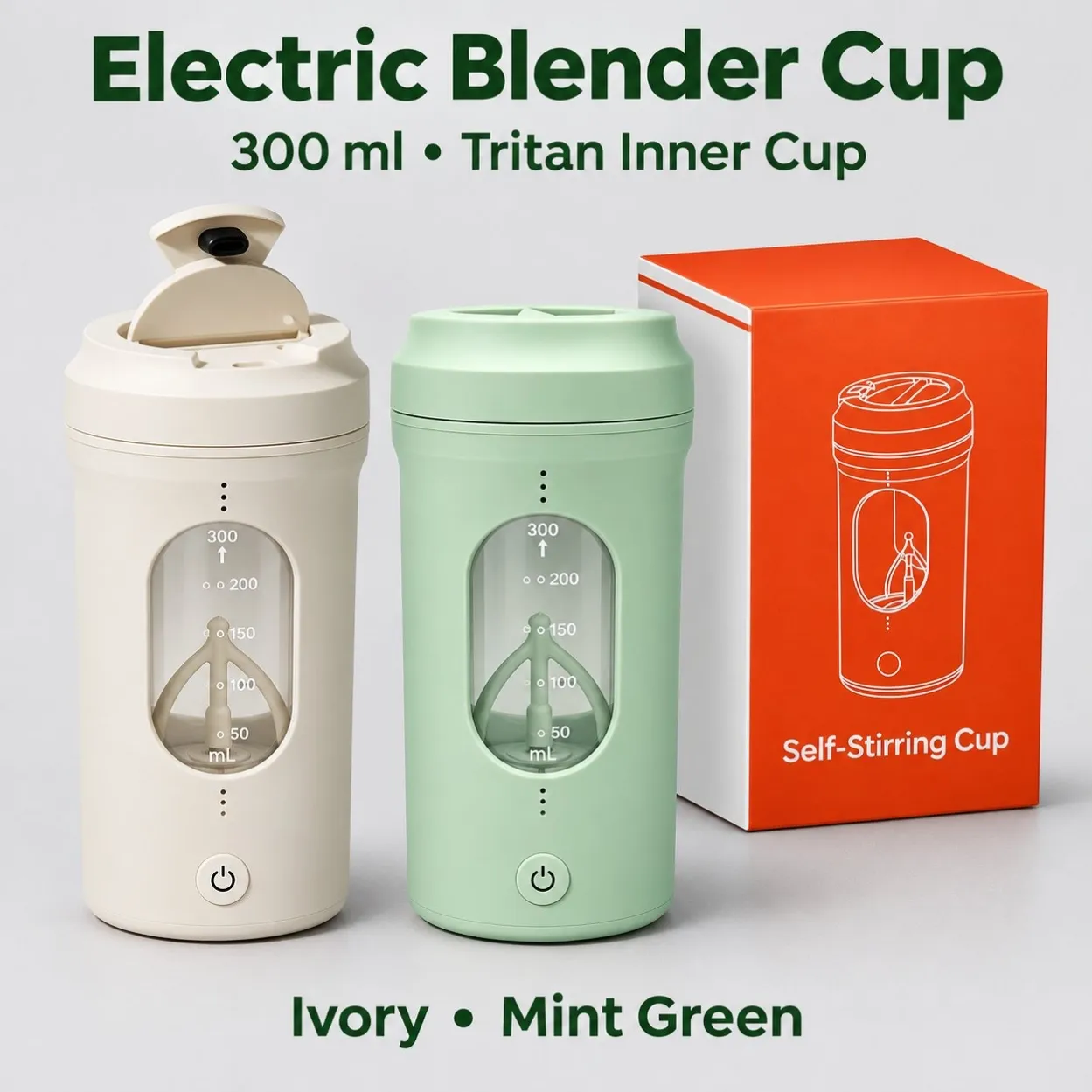
Protein servings vary, and so does the size of the shake once water or milk goes in. A bottle in the 300 to 450 ml range suits a single scoop or a meal-replacement sachet. A larger bottle, up to 800 ml, suits a full serving with ice, or a customer who mixes two scoops at once. Pick the size your best-selling product actually needs, not the biggest one on the shelf. An 800 ml shaker with an LED light ring is a good fit for a full-size protein serving, and it photographs well for a product launch. For a smaller, everyday option, a 350 to 450 ml bottle is the workhorse.
Materials your customer can trust
Most customers now check what their bottle is made of. Food-grade Tritan is the standard for a clear shaker: light, BPA-free, and hard to shatter when it gets dropped on a gym floor. For a premium option, a 316 stainless steel liner keeps drinks fresh and gives the product a weight that feels like quality — a temperature-display steel mug works well as a loyalty gift or a higher-priced bundle item. Borosilicate glass suits a blender-style cup for customers who prefer glass. Whatever you choose, the material should be easy to explain in one line on your own product page.
Power that fits how your customer lives
Most electric shakers now charge by USB-C, with batteries across our range from 800 to 2,000 mAh — enough for weeks of daily shakes on a charge for most people. That is the right choice for most brands. But there is one exception worth knowing: if you sell into markets where lithium batteries complicate air freight, or you want a shaker for events and travel packs, a model that runs on two AAA batteries avoids the shipping restriction entirely. Match the power to the route the product will actually travel.
Cleaning without a fuss
A shaker that is hard to clean becomes a shaker that smells, and a shaker that smells gets thrown away. A wide mouth, a base that comes off, and smooth surfaces inside the cup make a real difference. Water resistance helps too — across our range, bottles are rated from IPX4 splash resistance up to IPX6, so a rinse under the tap after use is not a worry. Tell your customers how to clean it in one line on the packaging, and they will keep using it.
Making it yours
A plain shaker is a commodity. A branded one is a product. Logo printing turns the bottle into your packaging: your mark on the cup, your colours on the lid and base, your box around it. Keep the design simple — a logo that reads at arm's length on a gym floor beats a busy print that disappears at a distance. Match the colours to your brand, not to the factory's catalogue, and ask for a printed sample before the full run so you can check the logo the way your customer will see it.
Think about the shaker as part of a kit, not a single item. The first-order kit is the classic format: powder, shaker, and a scoop, boxed together. A subscription box can add a new colour each quarter. A gym launch can pair a shaker with a towel or a trial sachet. These are the formats that turn a free gift into a reason to order again, and they are exactly what promotional-product distributors and corporate gift buyers already do well — our corporate gift guide covers the same idea from the gifting side.
Ordering without surprises
Custom shakers are made to order, so plan the timeline the way you would plan a product launch. Our minimum order is 1,000 pieces, and the lead time is 15 to 20 days from confirmed artwork to shipment. That means the order for a January launch should be placed well before the new-year rush — the fitness market peaks in January, and the brands that sell through it are the ones that ordered in the autumn. If you are planning around a trade show or a product launch, work backwards from the date and leave a week of slack.
Samples come first, and they are charged — a paid sample is the honest way to check the product, because the factory treats it like a real order. Order the sample in your own colours with your own logo if you can; a plain sample tells you about the bottle, but only a printed one tells you about your brand on it. Payment is by telegraphic transfer, and we ship worldwide by express courier, sea freight, or rail, depending on order size and destination. We reply to inquiries within one hour — email us at sales@mselectronicgifts.com — and if you want the full checklist before you start, our B2B buying guide walks through every step.
One more thing worth doing early: talk to your supplier about the whole range, not just one bottle. A brand that sells both a standard shaker and a premium steel mug needs both to feel like the same brand. Ordering them together keeps the colours, the logo, and the packaging consistent — and it is usually simpler than ordering twice. Browse the full range on our shaker bottles page, and if you want a second opinion on which bottle fits a gym chain or a fitness studio, our gym and fitness guide covers that buyer in detail.
Frequently Asked Questions
What is the minimum order for a custom shaker?
1,000 pieces. That applies to every order, whether it is one design or a mix of colours in the same model.
Can we print our own logo on the shaker?
Yes. Logo printing is available on the cup, and we can match colours and packaging to your brand. Ask for a printed sample before the full production run.
How long does an order take?
The lead time is 15 to 20 days from confirmed artwork to shipment. Allow extra time around the January fitness peak and before trade shows.
Can we get samples before ordering?
Yes. Samples are charged, and the fee depends on the model. A sample in your own colours with your own logo is the best way to judge the finished product.
How do we pay, and how does it ship?
Payment is by telegraphic transfer (T/T). We ship worldwide by express courier, sea freight, or rail transport, depending on order size and destination. We reply to inquiries within one hour — email us at sales@mselectronicgifts.com.
Next steps
Start with the bottle your best-selling product needs, get a printed sample in your colours, and check the mix, the seal, and the logo the way your customer will. If you want help choosing, contact us — tell us what you sell, who buys it, and when you need it, and we will suggest the right bottle and the right order size.