A new member signs up in January. The welcome kit lands in their hands: a towel, a wristband, a shaker. Of everything in that kit, the shaker is the one they will touch every single day. It rides in their gym bag, sits on the floor beside the bench, gets rinsed in the locker-room sink and filled again before the drive home. If it works, your club's logo is in their hand twice a day. If it leaks, the logo is on their car seat — and the complaint is at your front desk.
That is why gym chains buy their own shaker instead of letting members bring whatever they find online. A chain buys in volume, puts its own mark on the cup, and hands every location the same thing. The question is not whether to do it. The question is what to check before you order a thousand of them.
Why a chain buys its own shaker
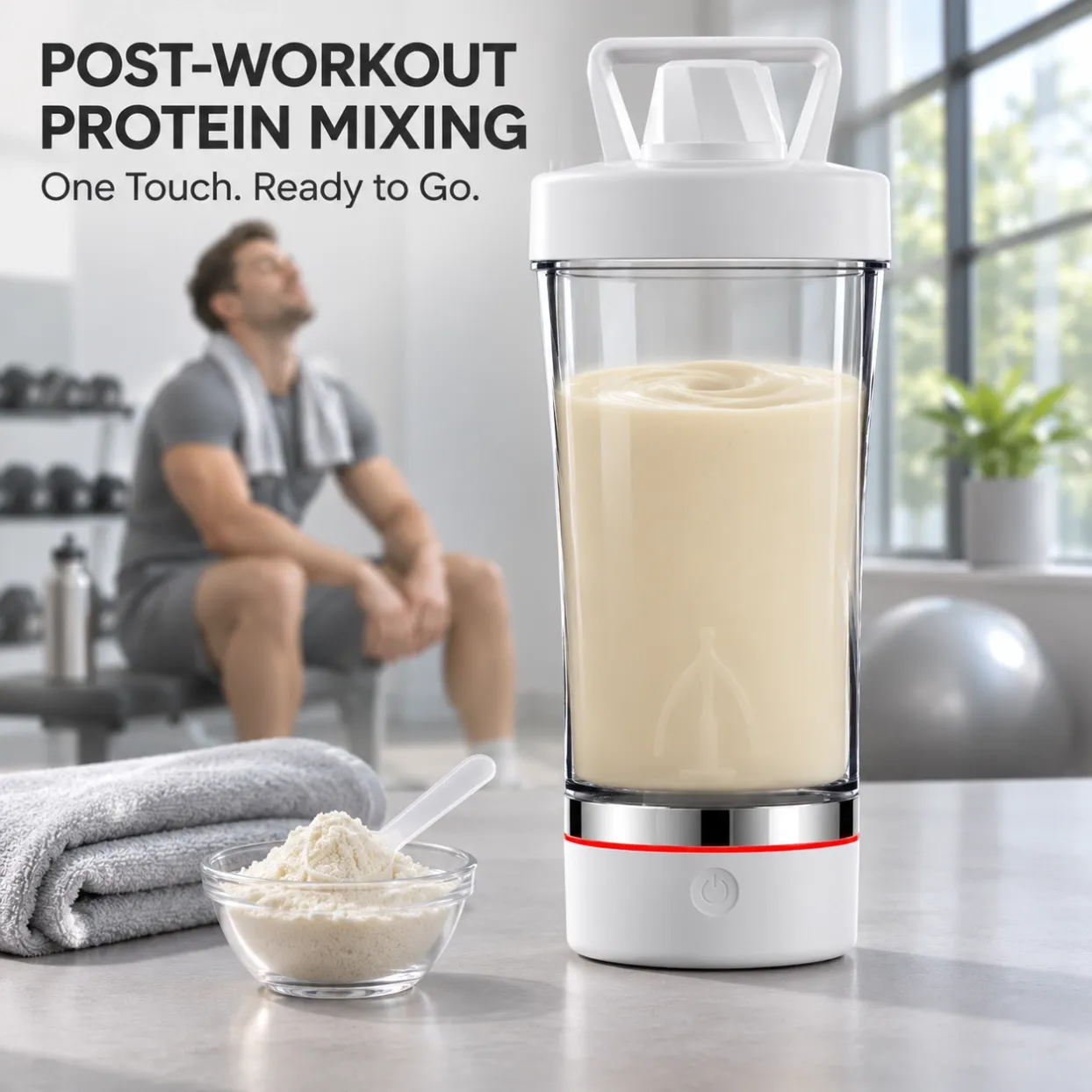
A hand shaker is cheap and everywhere, and that is exactly the problem. Members shake by hand, the powder clumps, they blame the protein — and sometimes they blame the club that sold it to them. An electric shaker mixes the drink properly, and the member's routine gets easier. That is the whole point of the purchase: a small piece of equipment that makes the core habit — a protein shake after training — work without a second thought.
For a chain, the shaker also does quiet work that no poster does. It carries the brand into the member's kitchen and office, not just the gym floor. It gives the front desk something real to sell instead of another keyring. And it gives every location the same member experience, which is what a chain is selling in the first place.
The catch is scale. One bad cup is a refund. A thousand bad cups across forty locations is a reputation problem. So the buying decision has to be made on the things that actually break.
What breaks first — and what to check
Ask any gym manager what goes wrong with shakers and the answer is always the same list, in the same order.
First, leaks. A shaker lives in a bag next to a phone, a wallet and a change of clothes. If the lid seal fails, the member finds out on the way home. Before you order, check the lid design: a flip-top lid with a drinking spout, a seal that closes with a clear click, and a base that stays tight when the cup is shaken hard. Ask the supplier how the seal is built, not just whether the cup is "leakproof" — every listing says that.
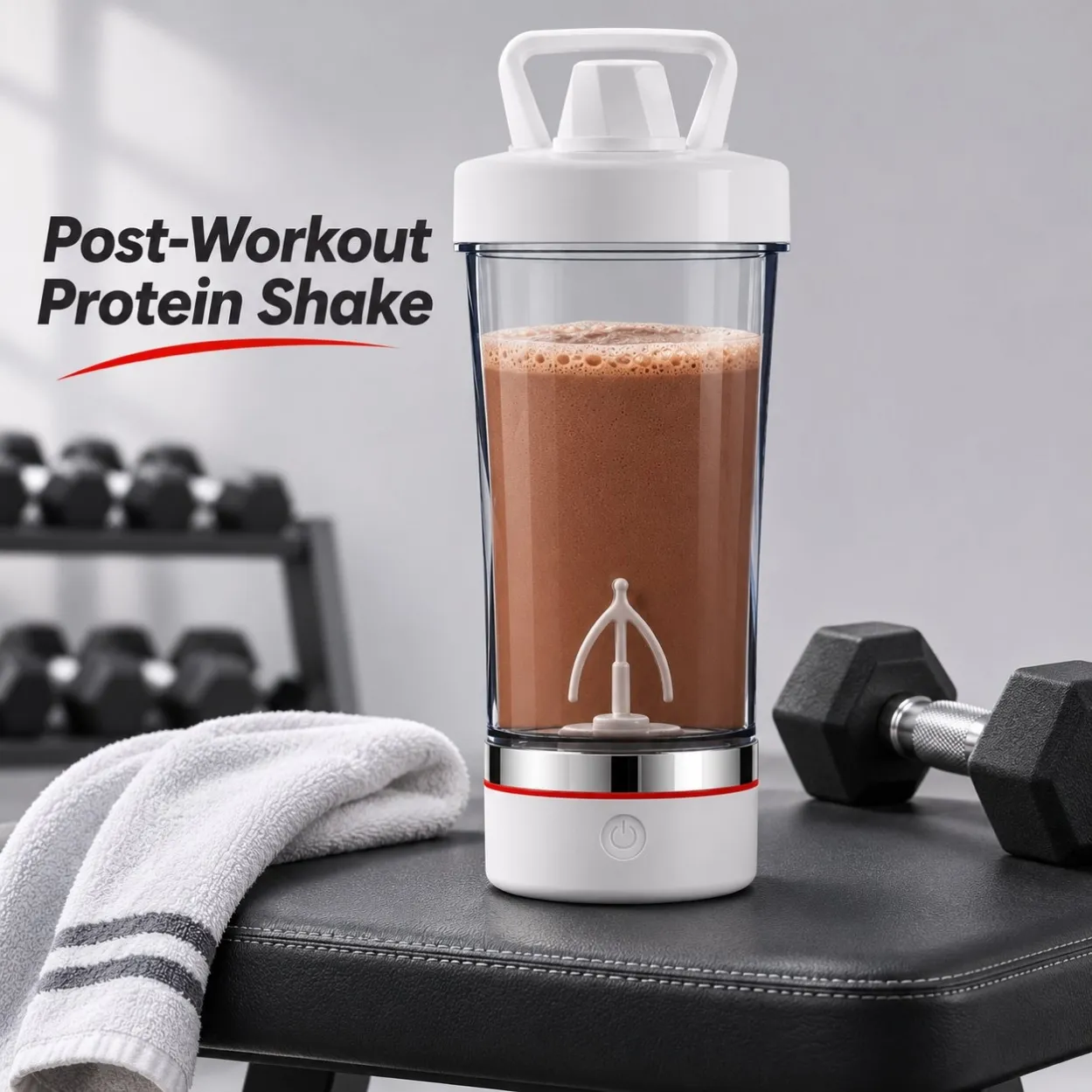
Second, clumps. Protein powder that does not mix is the single most common complaint about any shaker, electric or not. The fix is mechanical: a stirrer that actually moves through the whole drink. The models we carry use a Y-shaped stirrer at the base, and the motor speeds run from about 7,000 to 18,000 revolutions per minute across the range. A three-second mix is what members notice — press the button, the drink is smooth, they move on. If your members mostly drink whey, any of these speeds does the job. If they mix thicker drinks — meal replacements, oats, peanut butter — the higher end of that range matters more.
Third, cleaning. A shaker that is hard to clean becomes a shaker that smells, and a shaker that smells gets thrown away. Look for a detachable base, so the member can rinse the mixing parts separately, and a wide mouth they can actually reach into. The habit that keeps a cup in use is simple: rinse it right after the shake, before the protein dries. Tell your trainers to say that out loud in week one. It is worth more than any cleaning feature on a spec sheet.
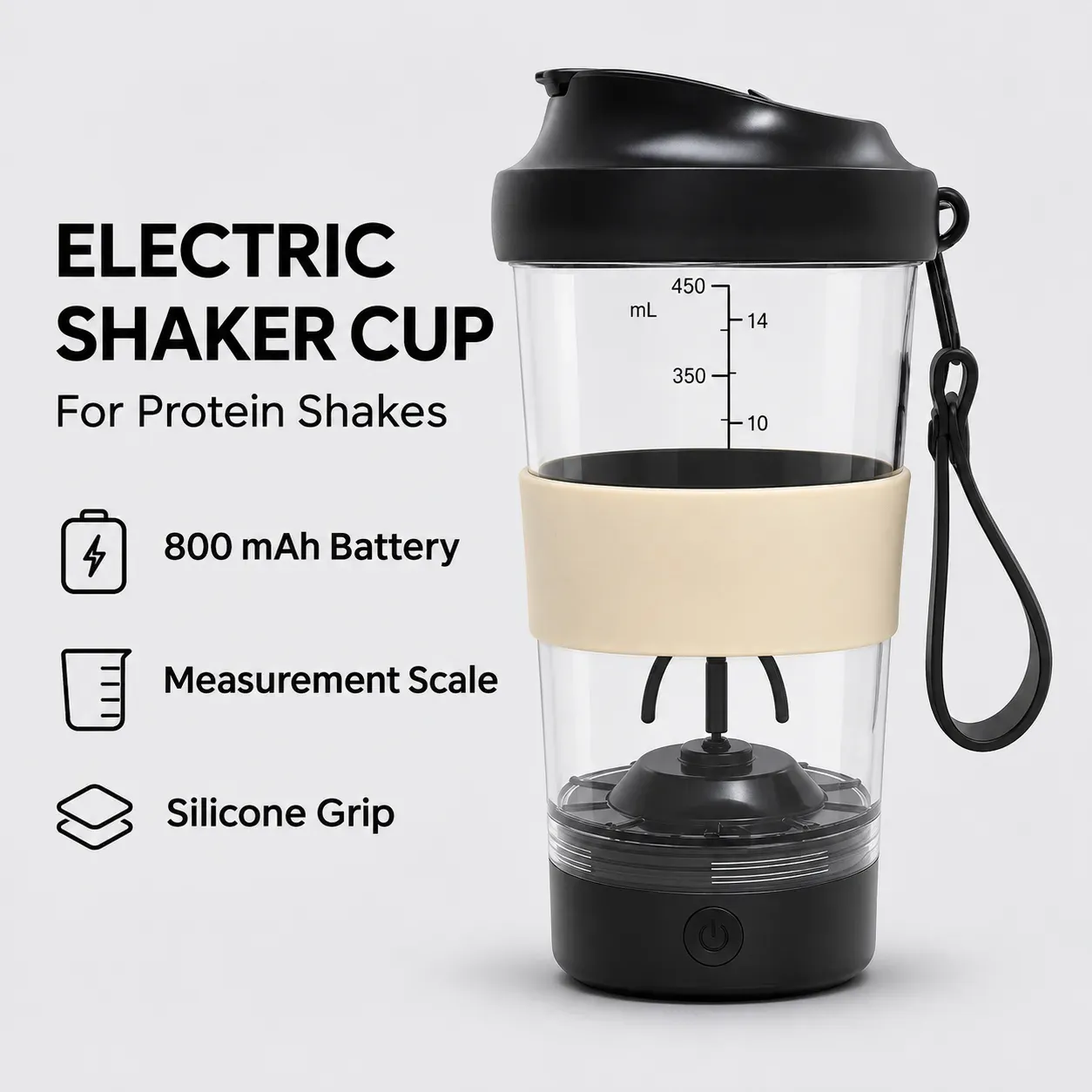
Fourth, the battery. An electric shaker is only useful if it is charged when the member needs it. Most of the models we carry recharge over USB-C, with batteries from 800 to 2,000 milliamp-hours. The one model that publishes a runtime states about 100 minutes per charge — weeks of daily shakes, not days. For locations where charging is awkward, or for stock that travels by air, there are also models that run on two AAA batteries instead. Pick the charging method by how your members actually live, not by what looks newest.
Capacity: pick by use, not by the biggest number
Shaker sizes in our range run from 300 millilitres for a light daily carry, through 350 to 450 millilitres in the middle, up to 800 millilitres for the big cups — and on the big ones the fill mark sits at 600 millilitres, with 800 as the full capacity. The mistake is to buy the biggest cup for everyone. A member who drinks one scoop after training does not want to carry an 800-millilitre bottle all day, and a member who mixes a full meal replacement does not want to make it in two batches.
For a chain, the practical answer is usually one size for the standard kit and a bigger size for the heavy users. A 400-millilitre cup covers most post-workout shakes. An 800-millilitre cup covers the members who train twice a day or mix meal replacements. If you can only pick one, pick the middle — it is the size the most members will actually use every day.
One design or two tiers
Some chains order one design for everyone. Others order two: a standard cup for the welcome kit and a premium cup for retail or for a higher membership tier. The premium features worth paying for are the ones members can see and feel — a temperature display on a steel mug, or a light ring on the base. They do not change how the drink mixes, and they are not the reason a member keeps using the cup. They are the reason a member picks it up at the front desk and pays more for it.
Our advice is simple: make the standard cup the workhorse — leakproof, easy to clean, mixes well — and let the premium cup be the upgrade. Do not make the premium features the thing your whole order depends on. If the standard cup is right, the program works. If it is wrong, no light ring saves it.
Ordering for a chain: numbers and timing
A gym chain crosses the minimum order quantity the moment it adds up its locations. Our minimum is 1,000 pieces for any order. A single boutique studio ordering on its own usually needs 100 to 500 pieces, which is below that line — but a chain ordering for ten locations at 100 pieces each is already there, and a chain ordering for forty locations is ordering for its whole year. Split the shipment by location when you order, and the stock lands where it is needed instead of piling up at head office.
Lead time is 15 to 20 days from a confirmed order, and your logo goes on the cup as part of the order — that is the point of buying custom. Samples are paid, not free, so order one or two first and put them through a real week: in a bag, in a car, through the dishwasher cycle your members actually use, shaken with the thickest drink on your menu. A sample that survives a week in a trainer's bag tells you more than any page of specifications.
Timing matters more than most buyers expect. January is the peak — New Year resolutions fill every gym in the country — with a second peak from April to June and a smaller one in September. With a 15-to-20-day lead time, an order placed in September or October is on the shelf for January. An order placed in January is late. If your chain runs a January joining campaign, put the shaker order on the same calendar as the campaign, not after it.
Payment is by telegraphic transfer, shipping is by express courier, sea freight or rail depending on order size and destination, and we reply to inquiries within one hour. Those are the mechanics. The decision itself is the list above: seal, mixing, cleaning, charging, size.
Rolling it out
The cup only earns its place if members actually use it, and use follows three moments.
The first is the welcome kit. Put the shaker in the new member's hands on day one, filled with their first shake, and show them the button. A member who mixes a smooth shake on their first visit has one less reason to feel lost in the gym.
The second is the front desk. A shaker on the counter sells itself to the member who forgot theirs, and it sells at a margin a towel never will. Keep one filled with water on display so members can feel the weight and press the button before they buy.
The third is the trainers. A trainer who uses the same cup every session is a better advertisement than any poster. Give your trainers the premium version and let them use it where members can see it. When a member asks where to get one, the answer is ten steps away.
None of this needs a launch event. It needs a cup that works, a logo that is easy to read, and stock in every location on the same day.