Product Knowledge
Electric Shaker Bottles for Promotional Products Distributors and Corporate Gift Companies
A branded gift only works if people keep it. For distributors and corporate gift buyers, here is how to pick an electric shaker bottle that prints well, arrives on time, and actually gets used.
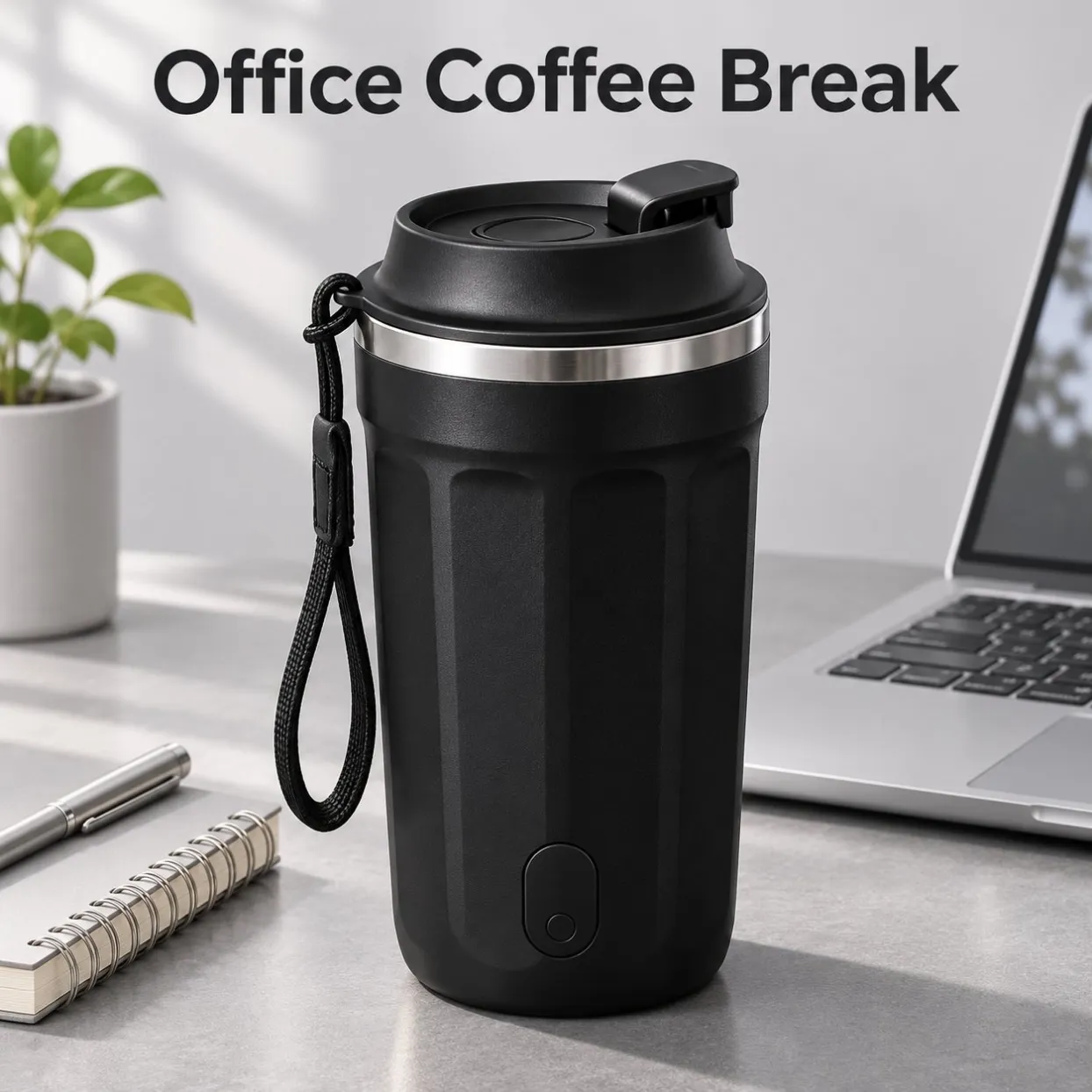
Every promotional products distributor knows the feeling. A client orders a few thousand branded items for a conference or a holiday gift program, the boxes arrive, the logo looks great — and six weeks later the items are sitting in desk drawers, or worse, in the bin. A logo nobody sees is money the client will not spend again.
The difference between merch that gets kept and merch that gets tossed is rarely the logo. It is whether the item earns a place in someone's daily routine. That is why an electric shaker bottle has become a serious option for corporate gifts and promotional programs — and why it also has more ways to go wrong than a mug or a tote bag. This guide is about choosing one your clients will be glad they handed out.
Why a shaker bottle survives where other merch does not
A protein shake, a morning coffee, a matcha at the desk: for a large share of office workers and gym-goers, mixing a drink is a daily ritual, and the bottle for it lives on the desk, in the gym bag, or in the car cup holder. A branded item that is used daily is seen daily — by its owner and by everyone around them. That is the whole point of a promotional product, and it is something a pen or a keychain cannot match.
An electric shaker adds one more thing: it feels like a real product, not a giveaway. A manual shaker with a wire ball is a commodity; a cup that mixes itself at the touch of a button feels like technology. When the recipient's first reaction is "this is actually good," the brand behind it gets the credit. When the first reaction is "this leaks" or "this doesn't mix," the brand gets the blame instead. That is the risk, and it is entirely avoidable if you check the right things before you order.
If you are comparing options, start with our B2B buying guide and our corporate gift guide — and browse the full range of electric shaker bottles to see what is available.
Corporate gift buyers are also under more pressure than they used to be. Wellness programs, onboarding kits, client appreciation gifts — the people receiving them compare them, consciously or not, with what they could buy themselves. A cheap, flimsy bottle next to a good one makes the giver look careless. A solid, well-finished one makes the giver look thoughtful. Distributors who understand that difference are the ones whose clients come back for the next campaign.
What makes an electric shaker a keeper
The first test is the one every recipient runs in the first week: does it mix properly? Protein powder that clumps, cocoa that settles at the bottom, matcha that stays gritty — any of these and the bottle is finished. A good electric shaker mixes a drink smooth in a few seconds, with a stirrer that reaches the whole cup rather than spinning in the middle. Before you commit to a large order, mix a real shake in the sample and drink it. If you would not use it yourself, do not put your client's logo on it.
The second test is the lid. A bottle that leaks in a bag is worse than no bottle at all, because it damages the laptop or the gym clothes next to it — and the recipient remembers exactly whose logo was on it. A flip-top lid with a proper seal, a base that unscrews for cleaning, and a body that fits a standard car cup holder are the details that decide whether the bottle becomes a daily companion or a cupboard ornament.
The third test is cleaning. A shaker that cannot be taken apart is a shaker that starts to smell. A detachable base, a wide enough mouth, and smooth inner surfaces that rinse clean in seconds matter more than any feature on a spec sheet. Ask how the cup is meant to be cleaned, and try it yourself with the sample. If it takes more than a minute, your client's customers will stop using it.
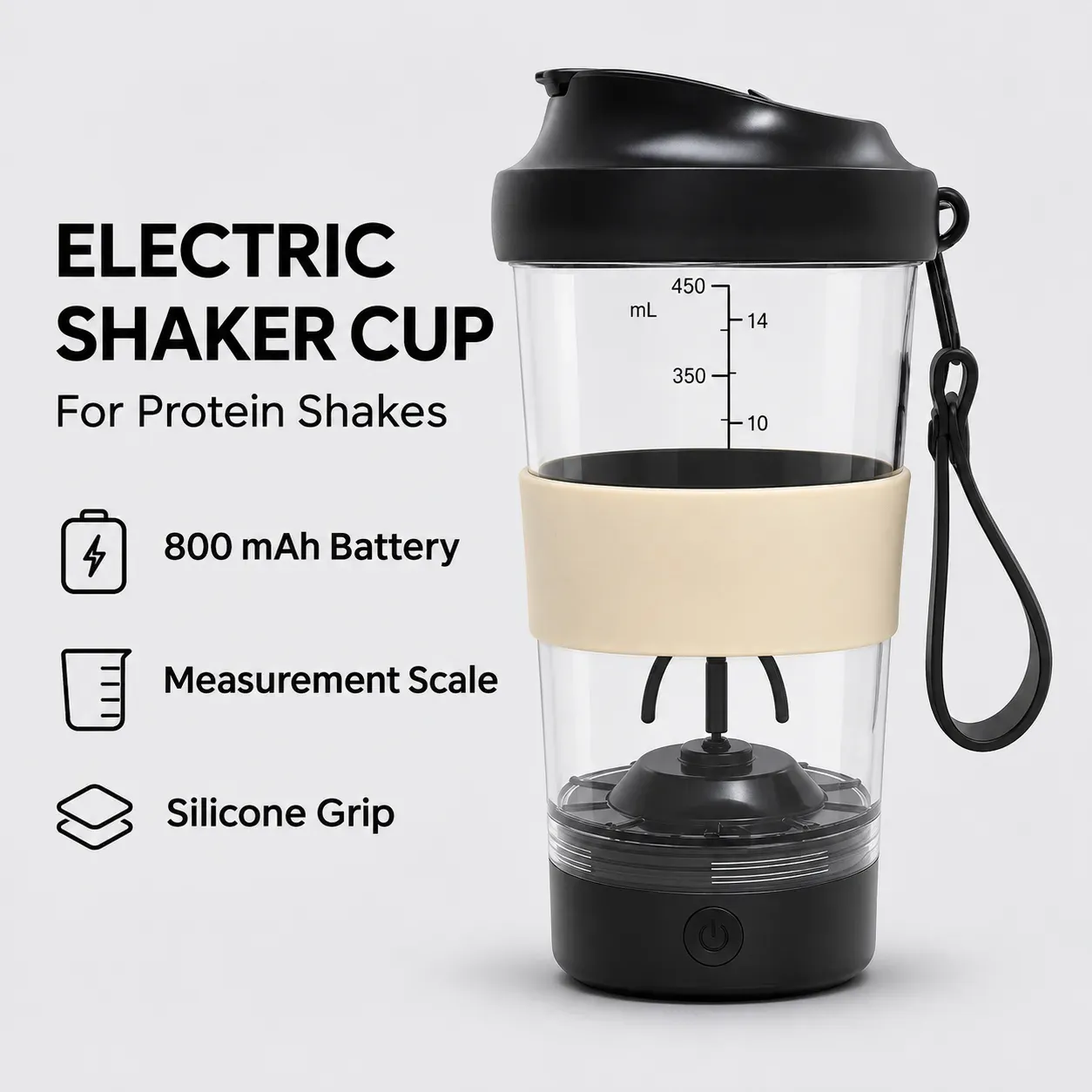
Battery and charging are the fourth test. Most electric shakers on the market now charge over USB-C, which is what people already have on their desks. A bottle that needs a special cable or a set of batteries creates a small chore every time it runs flat, and small chores are what kill daily habits. Check how the bottle charges, and how long a charge lasts in normal use — one charge should cover many drinks, not one.
Finally, the material. A clear, sturdy Tritan body shows the drink inside and survives being knocked off a desk; a stainless steel interior suits hot drinks like coffee and cocoa. Neither is right for every program. The question is who will receive it: a gym crowd wants a light, rugged training bottle, while an office audience may prefer something that looks at home on a desk next to a laptop. Match the material to the audience, not to the catalogue photo.
Logo printing: getting it right
For a distributor, the print is the product. A shaker that prints badly is a failed order even if the bottle itself is perfect, so this is where your attention should go first.
Start with the print area. Some bottles offer a large flat panel that takes a logo cleanly; others are curved or ribbed, which limits how big and how sharp the print can be. Ask the supplier for the exact print dimensions and, more importantly, for a photo of a real printed sample — not a mockup. A mockup always looks perfect. A photo of a finished bottle tells you the truth about edges, colour, and alignment.
Colour matching is the next thing to settle. A client's brand colour is not "roughly blue." Ask whether the supplier can match a Pantone reference or a printed sample the client provides, and confirm it on the pre-production sample before the full run. It is far cheaper to fix a colour on one sample than on a thousand bottles.
Durability matters too. A logo that washes off after a week of hand washing is a quiet disaster: the client only finds out when recipients complain. Ask how the print is applied and how it holds up to regular washing, and test the sample yourself — wash it a few times and see what happens. A good print should look the same after a month of use as it did on arrival.
One more thing distributors sometimes miss: the print proof. Before the run starts, get a digital proof showing exactly where the logo will sit, at what size, on which side of the bottle. Have the client sign it off. Most print disputes come down to "I thought the logo would be bigger" or "I thought it would be on the other side," and a signed proof ends that conversation before it starts.
Sizes and styles: matching the gift to the audience
Electric shakers generally come in a range from around 300 ml to around 800 ml, and the right size depends on who is receiving it. A compact 300 ml cup suits an office desk or a handbag; a larger cup suits someone mixing a full post-workout shake. If you are not sure, the middle of the range is the safest choice for a mixed audience — big enough for a real shake, small enough to carry.
Style matters as much as size. A gym-focused audience will forgive a sporty look; a corporate audience receiving a gift at a conference or in an onboarding kit will judge the bottle the way they judge any desk object — does it look considered, or does it look like a freebie? Neutral colours, a clean silhouette, and a lid that closes flush all help a bottle pass that test. Bright colours have their place too, especially for fitness events or younger audiences, but they should be a deliberate choice, not a default.
Think about what else goes in the box. A bottle on its own is a gift; a bottle in a gift box with a short insert card is a present. If the program is a premium one — a client appreciation gift, an executive welcome kit — ask about gift-box packaging and custom inserts. The unboxing is part of the impression, and it costs far less than upgrading the bottle itself.
Planning the order: timing, quantities, and reorders
Promotional programs live or die on dates. A conference, a product launch, a holiday gift deadline — the bottles have to be there, printed and packed, on the day. Electric shakers are made to order with custom printing, so the realistic lead time is around 15 to 20 days from confirmed artwork to shipment, plus transit. Work backwards from the event date and add a buffer. If the artwork is not final yet, the clock has not started.
The minimum order for custom-printed electric shakers is typically 1,000 pieces. That number surprises first-time buyers, but it is what makes custom printing viable: the setup for printing, the production run, and the quality checks are the same whether you order a thousand or ten thousand. If your client's program is smaller than that, it is better to know early and plan around it — for example by combining several smaller programs into one order, or by choosing a program that genuinely needs the volume.
Samples are the cheapest insurance in the whole process. Order a sample before the full run, print it with the actual logo, and use it the way the recipient will — mix a shake, carry it in a bag, wash it, charge it. A paid sample that reveals a problem saves an order that would have created one. Any supplier who resists providing a printed sample is telling you something.
Reorders deserve a thought before the first order, not after. If the program works, the client will want the same bottle again in three or six months. Confirm that the same model, colour, and print setup will still be available, and keep a record of the exact print specification — logo size, position, colours, print method. A reorder that matches the first batch exactly is what turns a one-off program into a repeat account.
Five questions to ask your supplier
First, can I see a printed sample with my client's actual logo before the full run? If the answer is no, that is a warning sign.
Second, what exactly does the lead time cover — production only, or production plus printing and packing? And what happens if the artwork needs a revision halfway through?
Third, how is the logo printed, and how does it hold up to daily washing? Ask for the answer in plain words, not marketing language.
Fourth, what happens if a unit arrives faulty or stops working? A supplier who has a clear answer for defects is a supplier who has dealt with them before and learned from it.
Fifth, can you hold the print specification so a reorder in six months matches this batch exactly? Consistency across batches is what keeps a distributor's clients happy.
Frequently asked questions
What is the minimum order for custom electric shaker bottles?
The minimum order is 1,000 pieces for custom-printed orders. This covers the printing setup, production, and quality checks that make a custom run viable.
How long does a custom order take?
Allow around 15 to 20 days from confirmed artwork to shipment, plus transit time. If the order is tied to an event date, work backwards from that date and add a buffer for artwork approval.
Can we print our client's logo on the bottle?
Yes, custom logo printing is available. Ask for the print dimensions, a digital proof showing the logo position and size, and a printed sample before the full run so the client can approve the real thing.
Can we get a sample before ordering in bulk?
Yes, samples are available on a paid basis. Order a printed sample with the actual logo and test it the way the recipient will — mix a drink, carry it, wash it, charge it — before committing to the full quantity.
What sizes are available?
Electric shakers generally range from around 300 ml to around 800 ml. A mid-range size suits a mixed audience; a compact cup suits office use, and a larger one suits post-workout shakes. Choose by who will receive it.